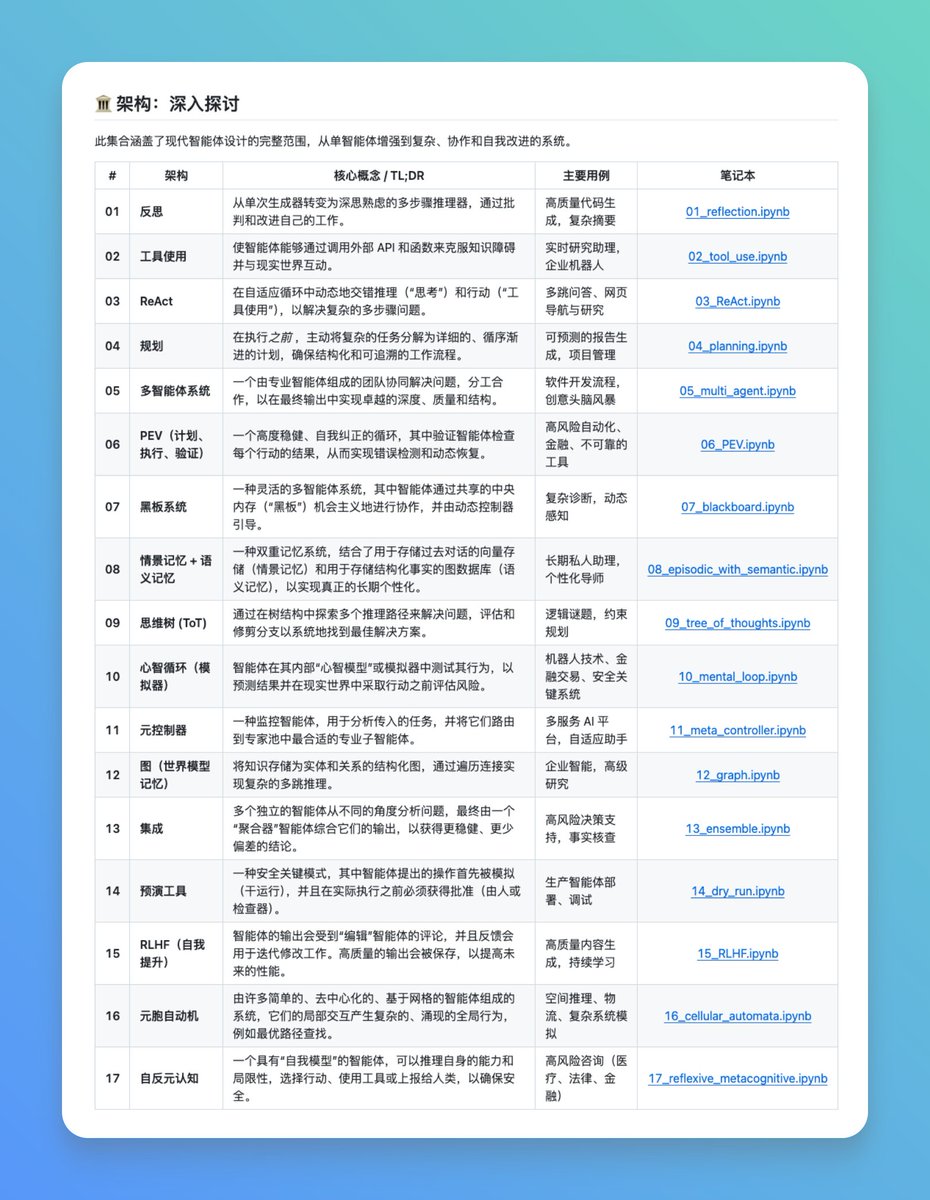
If you want to systematically learn AI Agent architecture, the tutorials on the market are often either full of obscure academic papers or overly simple demos, making it difficult to find truly practical code references. I recently discovered the open-source project all-agentic-architectures on GitHub, which can be described as a practical textbook for modern AI agent design. It includes 17 mainstream agent architectures, covering everything from basic ReAct and tool calls to advanced multi-agent collaboration, self-reflection, and correction. Using LangGraph for orchestration, we deeply analyze complex patterns such as mind trees (ToT), long-term memory management, and blackboard systems. GitHub: https://t.co/9y81Yst61s It provides a complete set of working Jupyter Notebooks, helping us transform abstract concepts into visible code, making them more than just theoretical concepts. A quantitative evaluation mechanism has been introduced, teaching us how to use LLM to score the performance of agents, which is crucial in production environments. This is an excellent resource for developers who want to gain a deeper understanding of the underlying logic of agents or are looking for advanced intelligent agent development paradigms.