
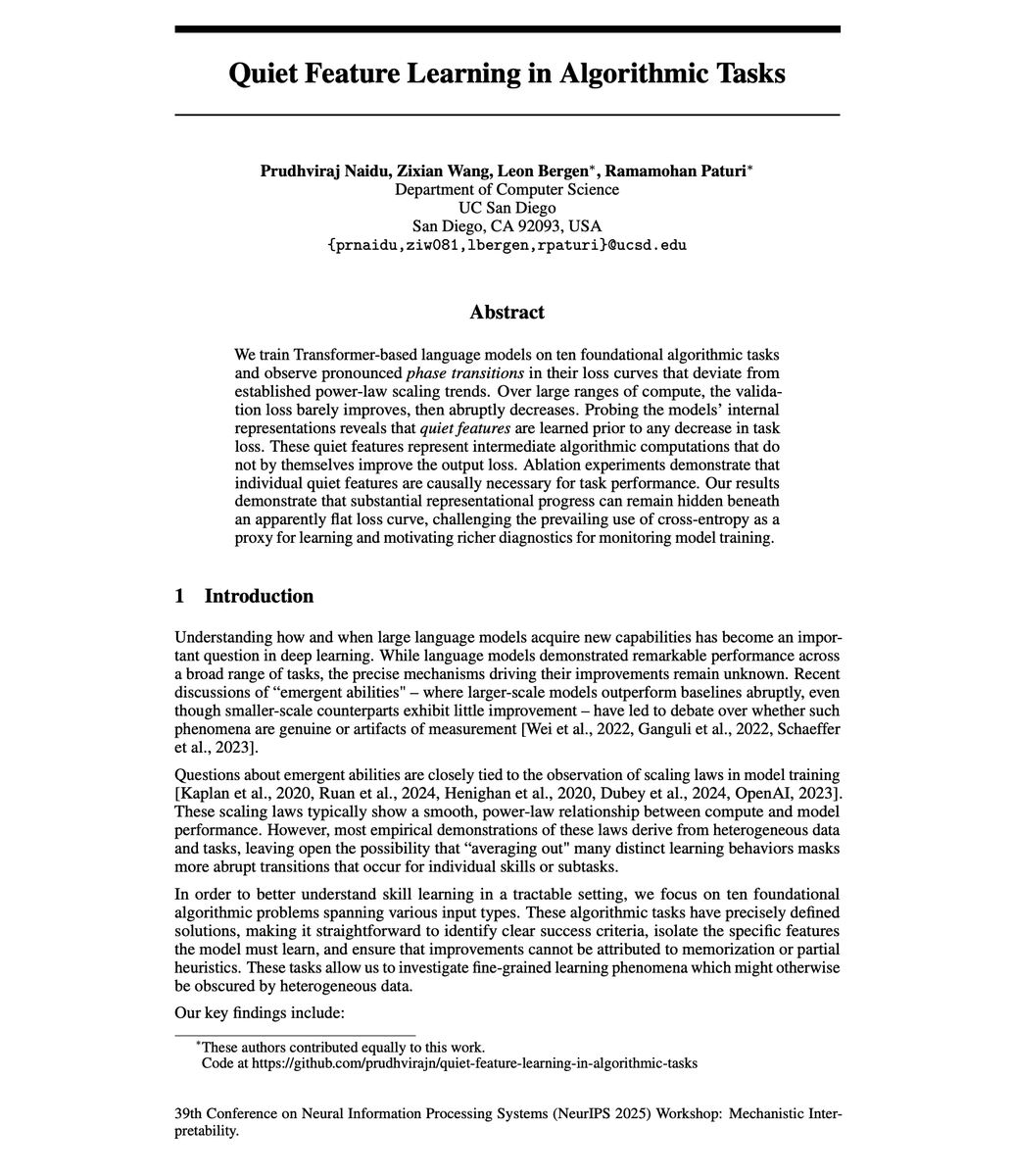
Silent Feature Learning in Transformers This is an interesting paper from this week: it points out that loss curves can mislead our judgment of what the model has learned. Typically, we use loss as the main metric for measuring the progress of neural network training. If the loss doesn't change, it's assumed the model hasn't learned anything; if the loss decreases, it's assumed learning is happening. However, this assumption does not hold true when dealing with algorithmic tasks. This new study used Transformer to process 10 basic algorithmic tasks and discovered “silent features”: internal representations continue to evolve even when the loss stagnates. The study found that the model had already learned the intermediate computation steps before it improved its output performance. For example: carry in addition, queue membership in BFS, and partial product in multiplication. These characteristics gradually form over a long plateau period, and then suddenly combine to solve the problem. Researchers explored the internal representations in binary arithmetic (addition, multiplication), graph algorithms (BFS, shortest path, topological sorting, MST), and sequence optimization (maximum subarray, active selection). All six tasks exhibited a clear two-phase transition: after a long period of stagnation, performance suddenly improved. The ablation experiment confirmed the causal relationship. Removing carry features from the 64-bit addition model reduced accuracy by 75.1%. Abolishing queue membership relationships in BFS reduced accuracy by 43.6%. The algorithm task requires multiple subroutines to work together. A single correctly aligned component will not reduce the loss until all parts are aligned. The model accumulates potential capabilities under a flat loss curve. It appears that cross-entropy loss is an incomplete diagnostic method. Even if the metrics appear stagnant, a significant amount of internal learning may be taking place. This prompted us to develop monitoring tools that offer more comprehensive support than just loss curves. 🔖 Paper link:
This content was gexaicreator.com https://t.co/Gxsobg3hEN
Thank you for taking the time to read this tweet! Follow @Yangyixxxx for AI information, business insights, and growth strategies. If you enjoyed this content, please like and share the first tweet to spread valuable information to more people.