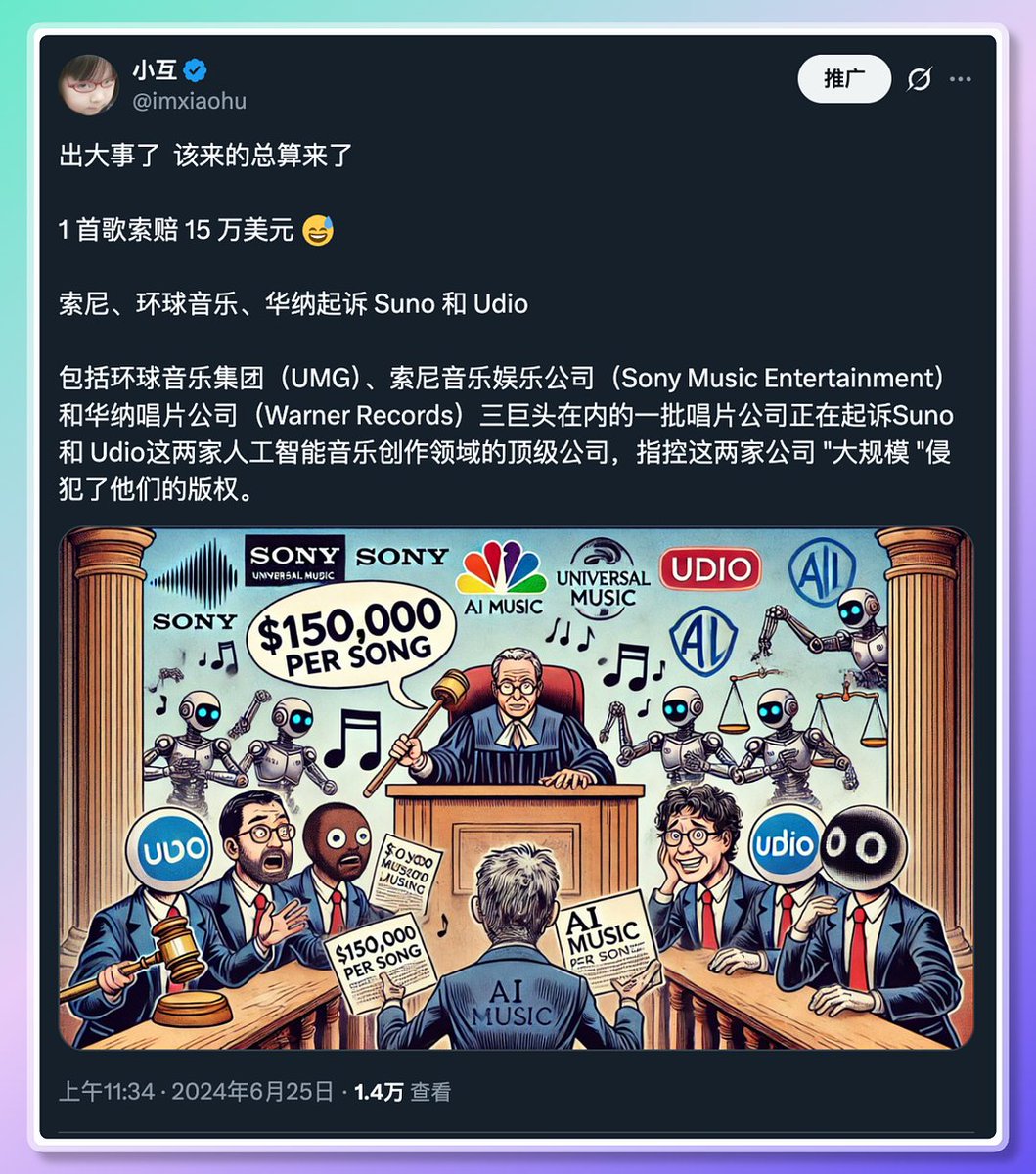
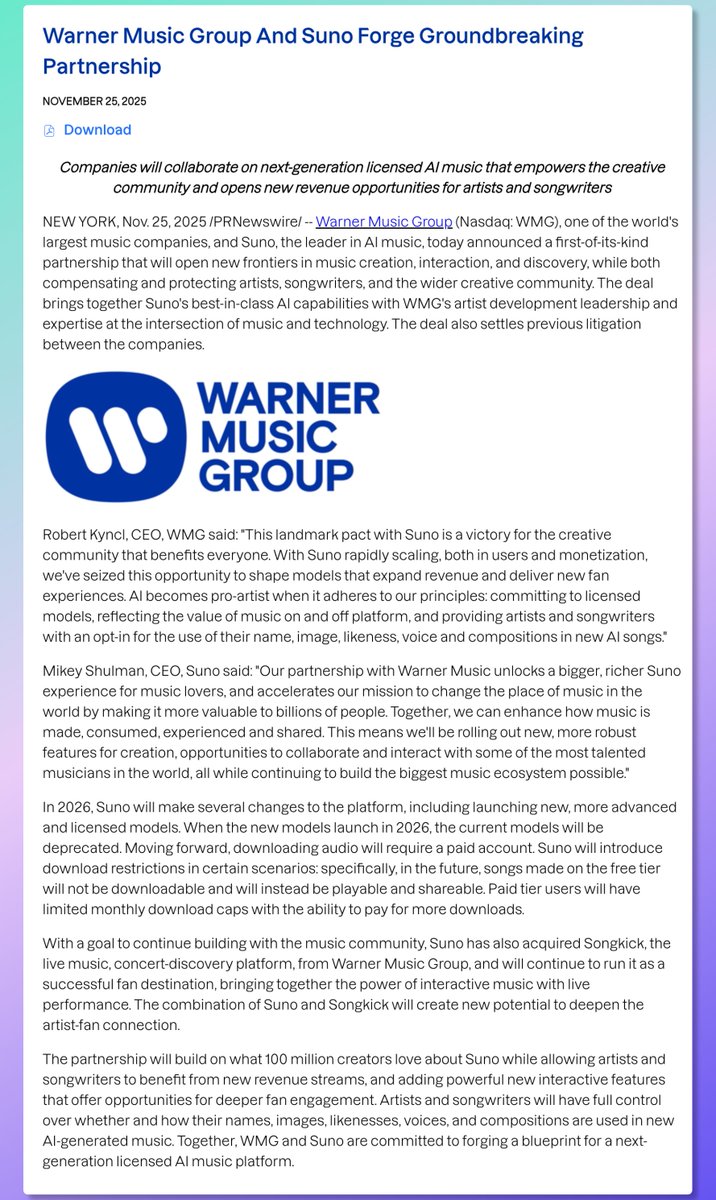
Milestone significance: If you can't beat them, join them. Warner and Suno reach settlement A historic handshake between copyright and AI In 2024, record companies such as Warner, Sony, and Universal Music launched a wave of copyright lawsuits against generative music platforms. One song is being sued for $150,000. A group of record labels, including the Big Three Universal Music Group (UMG), Sony Music Entertainment, and Warner Records, are suing Suno and Udio, two top companies in the field of AI-powered music creation, accusing them of "massive" copyright infringement. The record company submitted a USB drive containing specific prompts and generated music samples, claiming that these samples directly copied the original. The plaintiffs are seeking statutory damages of $150,000 (approximately RMB 1.094 million) for each song and allege that Suno copied 662 songs and Udio copied 1,670 songs. As one of the representative conflicts, Warner sued Suno, accusing the latter of using its music library and artist voice training models for commercial output without authorization. Suno's user base grew to over ten million within a year, with its valuation approaching $2 billion. Its AI-generated songs have been played over 10 billion times on TikTok and YouTube. From the perspective of the traditional music industry, this growth is due to: The result of unauthorized absorption of decades of music assets. Warner Music and other record companies stated: “You’ve used the entire history of music to train yourselves, but you haven’t asked us a single question.” The conflict quickly escalated into a public contest over the future of data power and copyright. However, at the end of 2025, an agreement brought the former enemies together: Warner announced it was withdrawing its lawsuit and has entered into a strategic partnership with Suno to jointly promote the licensed AI music ecosystem. This is not just a reconciliation, but more like a moment when the music industry takes the initiative to rewrite the rules. 🔑 What exactly does this collaboration mean? To explain this clearly, we've summarized all the publicly available and confirmed core details into one sentence: AI music will continue to develop, but from now on it must be incorporated into the copyright system and revenue shared according to clear rules. Specifically: Warner gave Suno: Music library licensing, voice and portrait rights cooperation mechanism, official revenue sharing system Warner Music has officially authorized Suno to use its licensed music library, audio, and other content. But the premise is— Artists under Warner Music have the right to choose whether or not to join. This signifies that, for the first time, rights such as voice, style, and name have entered into a commercial mechanism that allows for licensing, pricing, and negotiated allocation. Suno promises: In 2026, a brand-new licensing model will be launched to upgrade the copyright governance mechanism, placing "downloading" and "commercial use" within the framework of charging and compliance. Suno has promised to launch a brand new “licensed model” in 2026, and the old model will be phased out. Under conditions of authorization, revenue sharing, and controllability, it can be used to: ✔ Warner's music library ✔ Artists' voices, images, and works This means that the sources of training data will be open, transparent, and legal, and the production methods of AI will be subject to regulation. In other words, When you make songs on Suno in the future, you might choose to: 👉 "Have a real singer perform this song" 👉 "Replicating the voice and style of real singers" 👉 Moreover, it's all legal, and the celebrities can even get a share of the profits. This is the core revolutionary point of the whole story. This is the first time the industry has given this: The legitimate commercial pricing logic of singers as AI-trained assets. But here's the important part: From now on, music generated on the Suno platform can no longer be freely downloaded or distributed. Free users can only play and share; downloading and commercial use require payment and are subject to limits. In other words, the era of "getting a commercially usable master tape for free" is over. The last detail is very intriguing: Suno has acquired Songkick, Warner Music's show and tour discovery platform. This signifies that the platform is no longer just dealing with "digital works," but is attempting to reach the real market of the offline music industry. Do you want to upload the song to Bilibili, Douyin, and Spotify in the future? You must pay first to obtain authorization. AI music has officially evolved from a "toy" into a "business". ❗Why did they suddenly shake hands and make peace? Because it is an inevitable trend: If you can't beat them, join them. The development of AI music has outpaced the capacity of regulators and litigants to handle it. Some key indicators from publicly reported data: The number of songs created by Suno users has reached hundreds of millions. Short videos on TikTok featuring AI-generated music have garnered over 10 billion views. The growth rate of "AI cover" videos on YouTube is approximately 8 times per year. Leading platforms such as Udio and Suno have raised over $500 million in total annual funding. Even more astonishing cases: After an AI-generated song mimicking Drizzy's voice went viral on TikTok, the team attempted to release it, but it was quickly removed by a record company. An independent musician used Suno to release 50 songs in three months, directly propelling his monthly listeners on Spotify to over one million. This shows that: The entire creative structure has been reshaped by "user co-creation + AI production," and the music industry can no longer use the old order to cope with the new production relations. Therefore, Warner's partnership with Suno is not a compromise. Rather, it is about industrial self-rescue and restructuring. Musicians: From "Passively Being Used" to "Actively Participating in Revenue Sharing" This also means that the three core rights of musicians have been clearly priced: Voice likeness Style encoding Training rights derived from the work This allows musicians to: Decide whether to authorize, determine the scope of authorization, and directly participate in the profits. Sound and style have become tradable copyright units. This is an important asset type that the music industry has never defined before. 🎯A deal that changed the industry narrative past: AI is the infringer → Record company protects assets through litigation Now: AI as a business channel → Record companies use collaborations to boost valuations and revenue expectations. This is a typical strategic inflection point: The agreement between Warner and Suno marks a significant first step in shifting the focus from revenue defense to growth expansion. It tells us that technology will not stop because of controversy, but industry must find a legitimate way forward. Warner and Suno also provide a reusable paradigm: It's not about stopping technology, but about allowing rights and values to continue flowing through technology. Publishing industry, film and television industry, education industry, media industry... They will all face the same problems and the same choices in the future: How can training data be made legitimate? How should the derivative value of a work be distributed? How can human contributions continue to be valued in the technological age? The music industry was the first to provide an answer: Rather than being rewritten, participate in rewriting. Let technology bring a new order to creation and rights, rather than destroy them.